

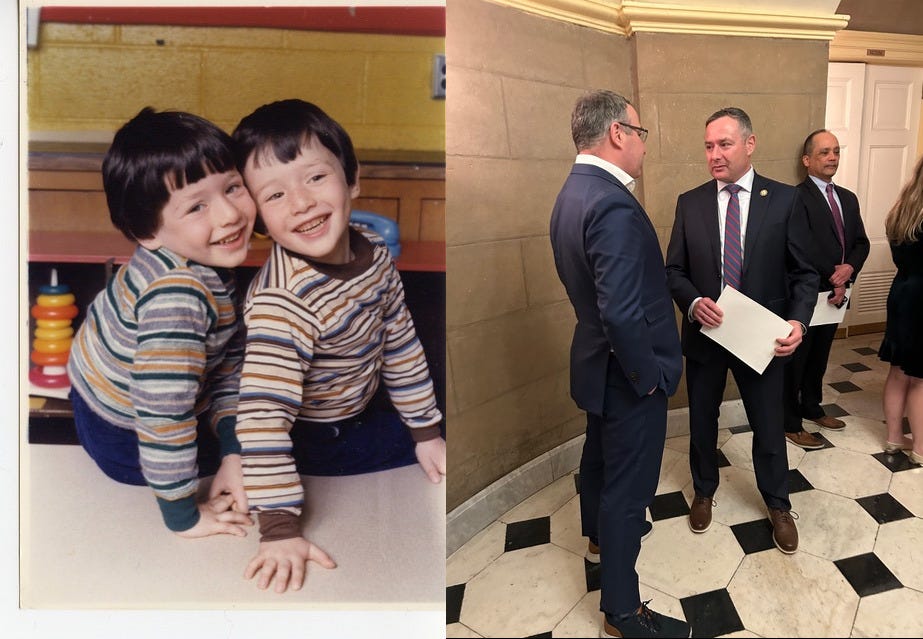
The 119th Congress has been in session for several weeks, but what have they been up to? I’m starting a new series looking at some of the votes the 119th has taken. As Eugene’s older, wiser twin brother, I’ll be “twinsplaining” the legislation and “twinalyzing” his votes as the representative for Virginia’s 7th District. This series aims to inform the public about key legislative decisions and offer insight into Eugene’s reasoning. By examining his voting record, we’ll explore how these decisions impact his constituents and reflect his principles.
Laken Riley Act
Eugene voted “Nay” on the Laken Riley Act, a piece of legislation that mandates ICE to bring undocumented immigrants into custody for crimes as minor as shoplifting. While there is an undeniable need to reform immigration laws and incorporate a common-sense approach to crime, this bill contained significant “poison pills” for many Democrats voting their conscience. The act lacked provisions for due process to determine guilt and introduced draconian detention protocols based solely on accusations of criminal activity.
Expanding ICE’s role to prosecute petty crimes like shoplifting raises serious questions about the legality and fairness of the bill. Additionally, granting ICE such broad authority risks exacerbating allegations of abuse that the agency has faced in recent years. Eugene recognized the political risk of voting against the bill, as it could be used by opponents to paint him as soft on crime. Nonetheless, he voted his conscience, understanding the importance of explaining the flawed legislation and his principled stance to his constituents. I’m proud of his resolve.
Preventing Violence Against Women by Illegal Aliens Act
In contrast, Eugene voted “Yea” on the Preventing Violence Against Women by Illegal Aliens Act. While this bill also has flaws, it focuses on deporting individuals who have either admitted to or been convicted of sex offenses against women and children. Importantly, the bill enforces this punishment only after due process has been completed, rather than acting on mere accusations.
Although I’m not a fan of mandatory minimums and prescribed punishments which strip agency from judges and juries, this legislation addresses the public’s demand for tougher immigration laws. It’s fair to say that serious crimes proven in a court of law should preclude individuals from remaining in the United States. Eugene’s support reflects his commitment to protecting victims while ensuring due process is upheld.
Illegitimate Court Counteraction Act
Eugene voted “Nay” on the Illegitimate Court Counteraction Act, which proposed sanctions on individuals assisting in prosecuting American or Israeli officials in the International Criminal Court (ICC). As a former Army JAG officer, ethicist, and advocate for international law, Eugene has a nuanced perspective. He supported the ICC’s warrant for Vladimir Putin’s arrest because under authoritarian regimes like Russia there is no effective judicial system to hold officials accountable. However, Eugene is critical of the Court’s decision to draw false equivalencies between terrorists who target civilian populations and western officials. Such cases deviate from the ICC’s mandate and precedent, as it traditionally avoids prosecuting individuals from states with functional judicial systems.
Eugene’s vote reflects a balance between condemning the ICC’s recent overreach and preserving its legitimacy as a tool for prosecuting war criminals. Undermining the ICC entirely would weaken its ability to hold individuals like Putin accountable in the future. Eugene’s decision demonstrates his commitment to the rule of law and international justice.
POWER Act
Eugene voted “Yea” on the POWER Act, which expands resources and authority for federal disaster relief organizations. Given the increasing frequency of extreme weather events across the United States, this legislation is a critical step in mitigating climate change’s devastating impacts. The act enables more robust responses to disasters, fostering reconstruction and resilience in affected communities. Eugene’s vote aligns with the pressing need for federal leadership in addressing climate challenges.
Looking Ahead
As the congressional term continues, I’ll periodically twinsplain Eugene’s voting record and twinalyze the reasoning behind his decisions. By providing this analysis, I hope to keep you informed about the legislative process and how it shapes the future of our country. Stay tuned for more updates—and don’t forget to share your thoughts or questions as we dive into the nuances of policy-making together.
This is exactly the kind of straight shooting/no BS updates we need... That America needs. Every politician should do this. Well done.
Could you please tell us the outcome of these bills or whatever voted on thank you for all of this but the final vote would be nice to know