

This article is part of a series on Ukraine and corruption. Subscribe for part two, written by corruption expert Dr. Jodi Vittori, to be published soon.
As identified in a recent op-ed in The Hill by political scientist Alexander Motyl, corruption is not an issue unique to Ukraine. Luxury condominiums in London and New York stand empty and unoccupied due to their usage in complex wealth-hiding schemes by Chinese and Russian oligarchs. Sporting events are regularly held in Azerbaijan and Qatar, states known for corruption and authoritarian approaches to governance. Although the developed economies of Europe are regularly cited as examples of effective, non-corrupt governance, several EU members continue to use “Golden Visa” laws that grant permanent residency for wealthy investors - including persons that would be otherwise targeted by western sanctions. Certain American commentators have cited corruption in Ukraine as a justification for ending the United States’ security aid and have called for closer cooperation between the United States and Russia against China. Anyone seriously considering this hypothetical scenario should remember that Ukraine is 30 spots ahead of Russia on the 2022 Rule of Law index and continues to rise in anti-corruption rankings. These individuals would have us abandon our ally so that we may cooperate with a country that is directly adversarial to American interests and measurably more corrupt. Nevertheless, corruption remains a challenge in Ukraine. It is crucial that observers understand the origins of this corruption and how far Kyiv has come in battling what was once called Ukraine’s “existential threat” before February 2022.
Like much of Eastern Europe, Ukraine’s corruption may be traced to the country's time as a constituent republic of the USSR. Although the communist party presented itself as having a monopoly on the political and economic structures of the USSR, criminal networks and personal connections were routinely used by high-ranking officials in Soviet society as a means of acquiring wealth and smuggling luxury goods from Europe and the United States. Organized crime was also used as a tool by the Soviet government: members of the Russian mob in the United States acted as extensions of Soviet intelligence and prison gangs often received instruction and direction from Soviet authorities. Smuggling networks were routinely used by members of Soviet society to avoid frequent shortages of basic necessities and consumer goods during the twilight years of the USSR.
Organized crime and criminal networks found new opportunities in the institutional instability and economic destitution of Ukraine in the early 1990s. As in Russia, Ukraine experienced a largely mishandled transition to a market economy - particularly when compared to neighboring Poland. Individuals tied to organized crime, former members of the security services, and communist party bosses used coercion, brute force, and an opaque voucher privatization process to gain control of Ukraine’s industry. This led to the creation of Ukraine’s first oligarchy. During this period of dysfunction many of the “petty” forms of corruption, such as soliciting bribes for basic government services, were normalized in Ukrainian society.
While the 2004 Orange Revolution and Euromaidan are now viewed as Ukrainian society reorienting Kyiv towards a “Pro-Europe” or “Pro-Western” foreign policy, we should remember that widespread dissatisfaction towards the corruption of the pro-Russian Party of Regions and its leader Viktor Yanukovych was at the heart of both revolutions. The trigger for the 2014 Revolution of Dignity was Yanukovych’s acceptance of a $15 billion bribe to drop the very popular European Association agreement in favor of closer ties with Putin’s Russia. Alignment with Moscow and participation in Russian-led economic integration projects was a continuation of the status quo, rampant corruption. In comparison, association with the European Union (or even future membership) was seen as a means of delivering better institutions and standards of governance.
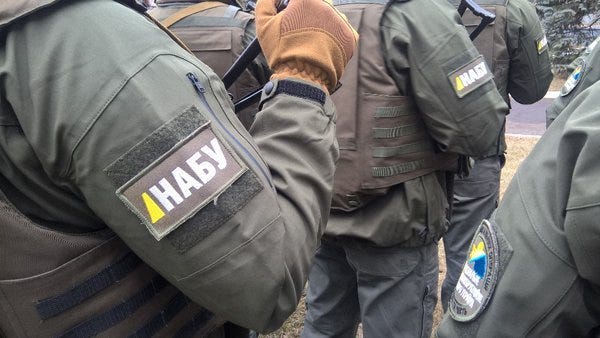
The fight against corruption has been at the center of Ukrainian domestic politics since 2014. Even with the immediate security challenges posed by the annexation of Crimea and invasion of Donbas, Kyiv was able to shutter the previously ineffective National Anti-Corruption Committee and unveil the new National Anti-Corruption Bureau of Ukraine (NABU) - an agency that works in conjunction with the FBI and European law enforcement agencies.
Kyiv’s ongoing process of European Integration has been a major vehicle for Ukrainian anti-corruption reforms. The signing of the EU-Ukraine Association Agreement and its affiliated Deep and Comprehensive Free Trade Agreement have provided Ukraine a set of governance and anti-corruption standards that must be met in order to fully accede to the market and political structures of the European Union. With Ukraine’s elevation from associate of the European Union to membership candidate, we can expect that Brussels’ expectations for Ukraine’s anti-corruption process will only increase and expand in scope.
Why is it that Ukrainian corruption is regularly framed as an impassable obstacle to American assistance, yet elected officials and pundits repeatedly call for cooperation with Russia - an objectively more corrupt country that is openly hostile to American interests? Politics may provide a better explanation as to why the claims of rampant corruption in Ukraine are used as a pretext for ending U.S. support to Ukraine. Republican congressmen are eager to please Donald Trump and walk-back their earlier support of Ukraine - “Ukrainian corruption” is a cudgel that may be used to brow beat anyone in the party that chooses to stand up to Russia’s aggression and Trump’s bullying. Outside observers should focus on Kyiv’s continuous progress in delivering meaningful anti-corruption reforms and the many legal mechanisms for accountability and review that are tied to American security aid to Ukraine.
I am marveling at the speed with which the pro Russia faction in the USA has grown since the Reagan years. There was a time when such thinking was anathema for most, if not all.
Thanks for this great reminder of Ukraine's recent history and how its attempts to throw off the yoke of Putinism (government by secret service/organized crime conglomerate) have led directly to the recent invasion. The criminal Putin state apparatus is fiercely trying to devour its prey... As to corruption, this is brazen criticism indeed from the Trump subsidiary of the Putin regime. Packing the White House with your children (and the multi-billion dollar pay-out after the fact to Kushner and Ivanka Inc from the Saudis)? Laura Trump as RNC Co-Chair? Paul Manafort (FSB much?)? Attempted shake-down of President Zelenskyy? Seriously? Do we need to go on?