

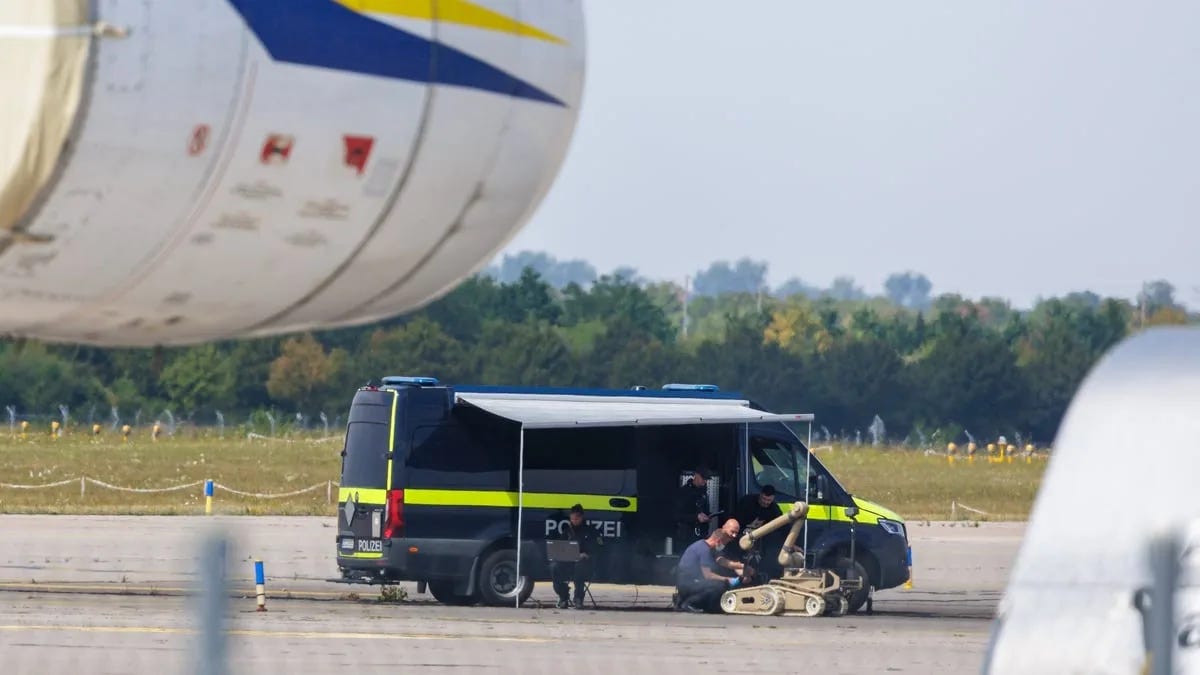
German police with a bomb-disposal robot near a Ukrainian aircraft at Leipzig airport
Explosions at an Italian shell factory. Jammed signals around the Baltic Sea. Drones and munitions found at a German airport. Disruptions in transportation, trade, and commerce.
With diminishing gains on the battlefield of an increasingly unpopular war, Moscow has turned its attention towards soft targets in Europe. With the diminishing returns of strikes on military and civilian targets in Ukraine, the Russian military and security services are leveraging the openness of European democracies to attack civilian and military targets through sabotage operations. Leveraging a large network of spies and criminal network accomplices, Russia is deploying saboteurs to disrupt the infrastructure and production centers critical to Ukraine’s war effort as well as unrelated civilian infrastructure in an effort to raise the cost of supporting Ukraine. Putin’s theory is that these attacks will erode support for Ukraine and position Russia for better prospects in the war or future peace negotiations.
This isn’t a new trend. The practice called “active measures” dates back to the heights of the Cold War and has revived and grown since the start of the full-scale invasion in 2022. Now with Russia’s military prospects on the decline, Russian active measures have surged. European law enforcement bodies and counter-intelligence agencies have been uncovering and dismantling networks of Russian agents for the last four and a half years - however, the scale of activities in the last six months has triggered major concerns over potential escalation. These activities were likely the cause behind CIA Director John Ratcliffe’s recent trip to Moscow.
Who are these agents of chaos and destruction? Sometimes these individuals are FSB and GRU officers, oftentimes operating with deep-cover and false identities (these operatives are colloquially known as the “illegals”). These agents have been activated after living years of living a double life in countries like Slovenia. These assets serve Moscow’s interest by attempting to infiltrate western organizations like the ICC or by committing overt acts of sabotage, like attempting to smuggle explosives into commercial airliners. Operations are sometimes executed using less-sophisticated actors: disposable “single use” agents are contacted and coordinated by Russian intelligence through platforms like Telegram (essentially functioning as gig-economy workers for sabotage operations). The primary goal of these operations is to disrupt western support for the Ukrainian military by delaying deliveries and physically destroying assets. The secondary goal is to erode public support for Ukraine across Europe by presenting acts of chaos and destruction as being an unavoidable associated cost of western support for Kyiv.
My assessment is that the Russian military is acutely aware of its own limitations and is turning towards sabotage operations to compensate for a lack of progress in the military campaign in Ukraine. At this point in the war, Ukraine’s advances in drone technology and domestic defense-tech have turned what was initially a David-and-Goliath struggle into a conflict between near-peer militaries. Despite an advantage in manpower, a larger supply of munitions and equipment, and a massive military-industrial base, Russia has shown itself to be incapable of decisive military operations and has become increasingly hesitant to commit to the same high-attrition battles and prolonged urban campaigns that defined the first years of Russia’s ongoing invasion. A sudden spike in casualties and the necessary mass mobilization required to maintain military operations could break the illusion of a successful war that Putin is trying to preserve. The flight of 113,000 Russians in response to rumors of a coming mobilization suggests that much of the Russian public would not be aligned with a full pivot to war-footing. Hence, Russia is willing to engage in active measures and direct attacks on Europe to undercut Ukraine’s war effort and pressure Europe to press Ukraine for peace. Unfortunately for Putin, he has once again miscalculated Ukraine’s and Europe’s resolve to deliver a Russian defeat and end an era of Russian aggression.
The recent incident at Leipzig airport marks a turning point in Europe’s approach towards Russian sabotage operations. According to German authorities, a UAV containing explosives failed to detonate and was found near a Ukrainian cargo plane. Later, a second UAV collided with a civilian Boeing 757 during a landing attempt. A third UAV was recovered on the grounds of the airport days later. Germany’s willingness to directly attribute this attack to the Russian government is a sign that Berlin has reached the limits of its patience. We can expect a combination of political and diplomatic responses from Berlin and Europe in response to Russia’s sabotage campaign, ranging from standard-fare expulsion of diplomatic staff to a concentrated effort by Europe’s security apparatus to detect and prevent active measures.
The more interesting developments will happen away from the public view as hybrid wars require hybrid solutions. Germany and other large western European countries may join the central and eastern European members of NATO and the EU in providing intelligence resources and enabling active measures against the Russian war machine. In lieu of a risk-averse policy of deescalation and appeasement, we could see the start of a tit-for-tat campaign by the Europeans against Russian assets. European security structures will heighten detection and interdiction of Russian assets and intelligence agencies may target the web of critical industries and pipelines around the world to disrupt Russia’s war machine. Just as Moscow frames chaos and destruction in Europe as the cost of supporting Ukraine, Europe may present increased sanctions and further exclusion from the world economy as a cost of allying with Russia.
As we transition into the winter months, we can expect a decrease in the tempo and scale of operations along the line of contact in Eastern Ukraine. Sabotage and disruption will be the focus of Russia’s strategy towards Europe and allies of Ukraine. An increasingly desperate Russia may turn its focus away from supply chains and logistics and instead orchestrate mass-casualty events near the winter holidays - time will show if Europe and the United States will meet this challenge.
Thank you, Lieutenant Colonel Vindman. As always, I have the highest respect for your assessment.
One question: In light of the trump administration’s link to Putin, what -in your educated opinion- did our CIA Director hope to achieve during his visit to Moscow?
The EU, NATO allies, and others need to ask loudly and often, for the United States to participate in anti-Russian (Putin) counter-sabotage efforts.