


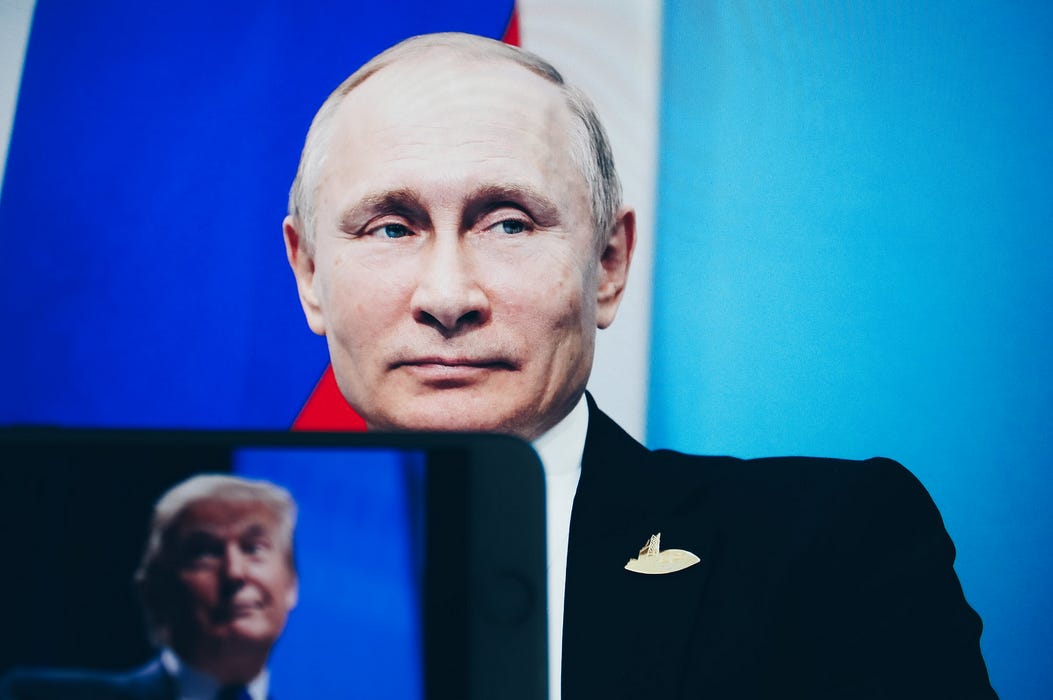
The upcoming meeting between Donald Trump and Vladimir Putin in Alaska this Friday is set to take place without any preliminary framework or agreed baseline between both parties. This is more than just an oversight - it is an invitation for trouble. Summits with foreign adversaries are complex negotiations that require months of behind-the-scenes preparation. The purpose of this process is to ensure that heads of state are finalizing a deal and not improvising a new agreement. In this case, there is no ceasefire in place, no mutual recognition of Ukraine’s sovereignty, and no agreed upon principles for security guarantees or monitoring. Instead, the president will walk into a room and rely on his instincts against a counterpart who has built a career exploiting exactly these kinds of open-ended encounters. For Putin, the prospect of facing an American president with no roadmap and little support must feel like a dream.
Leaving the meeting’s substance undefined creates a vacuum that Putin will be eager to fill. History has shown how dangerous this approach can be. Successful summits from Reykjavik to Camp David to Dayton began with rigorous diplomatic groundwork that narrowed disagreements and set clear expectations. Without that foundation, the outcome becomes a matter of who is better prepared to seize the initiative and direct the conversation. In this area, the advantage lies firmly with Moscow.
The stakes go well beyond Ukraine’s borders. What happens at this summit could determine the safety of U.S. troops, the credibility of NATO, and the cohesion of America’s alliances. In every plausible scenario the security environment for American forces becomes more dangerous as a result of this meeting.
One possible outcome is that Trump agrees to terms heavily skewed toward Russia such as territorial concessions by Ukraine, acceptance of Moscow’s expanded sphere of influence, or reduced military support for Kyiv (needless to say, Ukraine would reject these conditions and continue to fight). That would embolden the Kremlin’s appetite for further expansion, shake NATO’s deterrence, and keep Europe on a heightened state of alert. A miscalculation along a tense border in the near future could pull the United States into direct conflict under NATO’s Article 5 mutual defense obligation. In such a case, American service members would be in the middle of it.
Another possibility is that the meeting ends without an agreement. The fighting in Ukraine grinds on but now Washington will be further estranged from its European allies, many of whom have been left in the dark regarding this summit and the topics of discussion between Trump and Putin. The absence of a united front would make joint military planning more difficult, erode interoperability, and weaken the Western alliance’s ability to deter future aggression. This strategic drift could leave U.S. troops stationed in Europe less supported and more exposed to emerging threats.
The third scenario is that of the “optics win,” a shallow compromise that allows Trump to claim victory at home while granting Putin enough leeway to keep his long-term objectives intact. This outcome would be seen by every authoritarian leader as proof that the United States can be maneuvered into trading away strategic leverage for a press release and photo op of a smiling Trump holding up signed paper (a very Chamberlain-esque scenario). This would further alienate Washington from its allies and make American security partners a target for hostile actors who now believe they can extract concessions through pressure.
In all three cases, the effect is the same: NATO’s deterrence is weakened, Russia’s revanchism is encouraged, and the risk of U.S. troops being pulled into a high-intensity European conflict is increased. Given that the European theater is already tense, undermining the alliance’s credibility is like scattering gunpowder on the floor and daring someone to strike a match.
Putin’s opening demand that Ukraine withdraw from areas that the Russian military has failed to capture shows his confidence in shaping the agenda. Offering only the possibility of a ceasefire in return fits the Kremlin’s pattern: secure concrete gains in exchange for vague promises, then use those gains as a platform for the next push. Without firm conditions going in Trump risks validating this cycle.
For Ukraine, national survival depends on more than simply an end to the shooting: it requires binding, credible security guarantees that deter future attacks. For NATO, credibility rests on the principle that no member or partner will be left to face aggression alone. For the United States, national security depends on an alliance network that can respond rapidly and decisively to threats. A meeting that undermines any of these pillars is not just a diplomatic setback; it is a direct challenge to the safety of American service members and the stability of the international order they help uphold.
The only acceptable outcome from a U.S. perspective is one that leaves Ukraine’s sovereignty intact, integrates it firmly with the West, and provides enforceable protections against renewed Russian aggression. That is not the trajectory this summit is on. By going in without any substantial preparatory work, Trump has set the stage for outcomes that range from bad to disastrous for American security interests.
Diplomacy is supposed to reduce risks, not increase them. Walking into a high-stakes encounter with a hostile power without a plan is the opposite of strategy; it is gambling with the lives of American troops, the unity of our alliances, and the credibility of the United States itself.
Cover image sourced from here
Not only is trump completely unprepared, but he has the intelligence of a 5th grader. Meanwhile, Putin is a master criminal with decades of experience. He knows how to deal with trump and get what he wants. I keep remembering that this war could end tomorrow — if Putin so decided. He started it, he invaded, he’s putting up Russian bodies to achieve his desire to conquer Ukraine. The entire matter is in Putin’s filthy hands. And the idiot trump is going to play right into putin’s web. This is definitely a recipe for disaster. God help Ukraine!
I believe the only reason trump is having this meeting is the third scenario you outlined. He is not concerned about Ukraines' welfare, he only wants "optics and blank papers", enough to divert attention from the Epstein debacle.
And I do think putin has dirt on trump that trump doesn't want disclosed to the world. If so, it must be pretty bad, bad enough to bring the traitor-in-chief to his knees.
Either way, nothing good can come of a meeting between these two despicable men.