


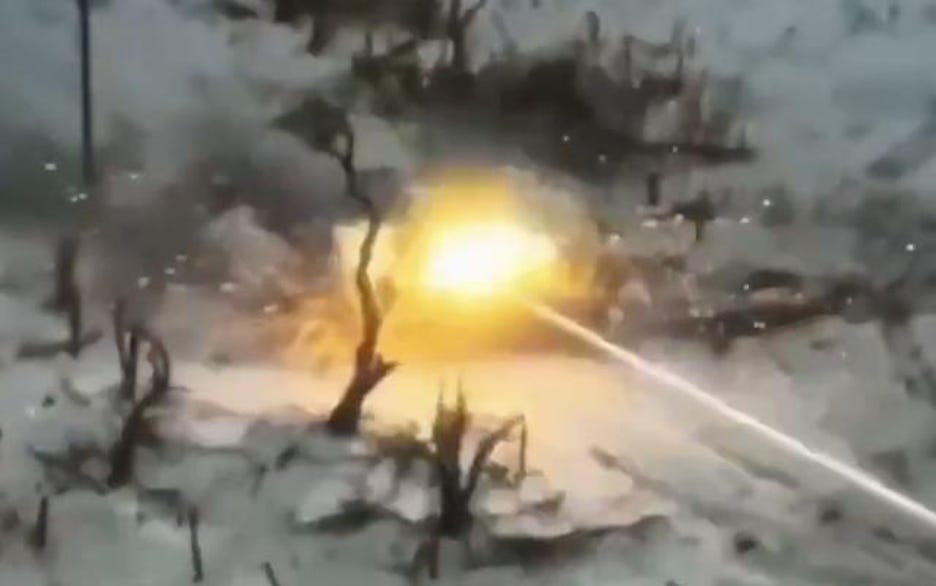
Still frame from footage of Ukrainian Bradley IFV destroying Russian T-90 near Avdiivka, Donetsk Oblast
This past weekend marked two years since the beginning of Russia’s invasion of Ukraine. The conflict has led to the death of thousands, the displacement of millions, and the return to interstate war on the European continent. During the lead-up to the invasion observers and commentators repeatedly highlighted the vast disparity in military capabilities between Russia and Ukraine. Moscow had an undeniable advantage over Kyiv in manpower, firepower, and production capabilities. The most generous Western estimates gave Ukraine several weeks of fighting before surrender while Moscow seemed convinced it would take Kyiv in three days.
The Ukrainians’ tenacious resistance in the opening days of the invasion dispelled any notion of a quick Russian victory. The reclamation of Kyiv Oblast and the sinking of the Moskva in the first weeks of the war demonstrated the Ukrainian military’s ability to punch well above its weight. By Fall 2022, Kharkiv and half of Kherson and Zaporizhzhia Oblasts were liberated from Russian control. Just as David slayed Goliath with a rock from his sling, Ukraine has leveraged its inventory of western equipment and a variety of asymmetric warfare techniques against the overwhelming size and strength of the Russian military. This piece will provide a broad overview of the strategies and assets used by Ukraine over the past two years in repelling Russia’s ongoing invasion.
Kyiv’s Drone Campaign
Parallel to the usage of repurposed hobby drones along the line of contact, Kyiv has developed several models of loitering munitions and strike drones designed for eliminating targets deep within Russian airspace. As early as April 2022 the Ukrainian military had repurposed a portion of its fleet of Soviet-built “Strizh” observation drones into makeshift cruise missiles by replacing the UAV’s cameras and imaging equipment with an explosive payload. These drones were used to conduct strikes on military assets located across the Ukrainian-Russian border in nearby oblasts inside the Russian Federation. After initial successes using these assets (the most noteworthy being an attack on Engels airbase), the Ukrainian military would begin production of its own line of drones. The UJ-22 developed by UKRJET is perhaps the most versatile of Ukraine’s fleet of unmanned aircraft and is capable of fulfilling a variety of battlefield support roles and delivering an explosive payload. This drone has been in production since at least 2021 and reflects Ukraine’s often overlooked military design and production capabilities. Loitering munitions like the “Bober'' are designed for long-range operations within Russian territory and have been used in strikes on government offices in Moscow. Initial successes with the recently developed anti-vehicle “Sych” drone suggests that the Ukrainian military may soon field its own analogue to the Russian anti-tank Lancet drone.
Extensive usage of unmanned systems has also allowed Ukraine to cripple Russia’s Black Sea Fleet. Systems like the “Seababy'' have frequently been used as a means of delivering explosive payloads to Russian naval vessels and docks. Additionally, footage circulated earlier this year shows the unmanned naval drone firing a volley of projectiles at a target - suggesting that the drone may also be used to strike shoreside infrastructure and facilities. The effectiveness of these attacks has led to the Russian Navy seriously considering relocating the Black Sea Fleet from Crimea to the Georgian territory of Abkhazia.
Nowhere to Hide
Over the past two years, Ukraine’s Main Directorate of Intelligence (HUR) has waged a campaign of sabotage and subterfuge against the Russian war-machine. Using data scraped from the internet, information sourced from personal networks inside Russia, and intelligence shared by the United States and other allies, the HUR has coordinated the destruction of factories and critical infrastructure throughout Russia. The assassination of Russian Naval Captain Rzhitsky during a jog in Krasnodar suggests that even senior military officials are not out of the HUR’s reach.
Beyond the Russian homefront, the HUR has managed to disrupt Moscow’s operations abroad. Media circulated in late 2023 shows four Ukrainian marksmen firing on Wagner Group positions in Sudan. Additionally, Wagner Group members reportedly came under attack from a pair of drones operated by an “unknown source”. These incidents were followed by the recent release of footage showing HUR operatives in Sudan interrogating captured Wagner Group members. Having permeated Russian society and successfully targeted Russian actors abroad, the HUR have shown an ability to rapidly innovate and adapt to today’s counterintelligence environment.
Hammer vs. Scalpel
With the exception of a brief period during the 2023 counteroffensive, the Russian military has maintained an absolute advantage over the Ukrainian military in total volume of munitions fired per day. Most estimates place the total number of rounds fired by the Russian military per day at around 10,000 compared to Ukraine’s 2,000. Rather than trying to match this volume of fire, the Ukrainian military has utilized its inventory of western-supplied artillery pieces and munitions to conduct precise, almost surgical strikes on select Russian targets near the frontline.
Few systems embodied this strategy more than the HIMARS. Four HIMARS were delivered to Ukraine in June 2022 shortly after the Russian capture of Severodonetsk and Lysychansk. The strategies used by Moscow in capturing these two cities were a reflection of the difficulties faced by the Russian military early in the war. After failing to capture Kyiv and experiencing fierce resistance in the Siege of Mariupol, the Russian military pivoted towards a more risk-averse strategy for navigating the industrial cityscapes of Eastern Ukraine. Russia’s strategy during this time was to saturate Ukrainian-held settlements with artillery fire and advance at a glacial pace, only moving to capture a town once it had become entirely indefensible. The Russian military operated under the assumption that Ukraine had limited capabilities for counter-battery fire near the line of contact. This led to the placement of ammunition dumps, command centers, and fuel depots a short distance from the battlefront.
With proper training a crew of three artillerymen can drive a HIMARS into position, unload a full volley of rockets in 45 seconds, and then drive away before the enemy can determine their location. The HIMARS was operable at night and standard munitions could be swapped for GPS-guided rockets if needed. After the arrival and deployment of the first HIMARS, the Ukrainian military would spend summer 2022 wreaking havoc on Russian targets near the line of contact. An unending series of nighttime strikes would see Russian ammunition depots, command centers, and staging grounds destroyed by a system that had no peer in the Russian inventory. Working in conjunction with drones and UAV spotters, this piece of American technology would also be used alongside older legacy artillery - Ukrainian forces would use rockets fired from Soviet-built Grad MLRS to overwhelm and deplete Russian air defense systems before engaging a target with HIMARS.
Ukraine’s usage of precision artillery as a means of compensating for Russia’s advantage in volume of fire goes beyond the HIMARS. European artillery like the Polish “Krab” and French “CAESAR” have been used by Ukrainian forces to strike targets deep behind Russian lines. Combining conventional artillery with guided “Excalibur” shells has given the Ukrainian military an unmatched range on the battlefield. Modern European cruise missiles like the “Storm Shadow” have been successfully retrofitted onto Soviet-built Ukrainian Su-24 aircraft and used to strike Russian naval assets and military infrastructure.
While Kyiv is unable to numerically match Moscow’s reserve of tanks and armored vehicles, we should consider how the lethality and survivability of American and European equipment compares to Russian hardware. The Russian military is believed to have lost 300 pieces of armor and 16,000 infantry in taking the city of Avdiivka. This is partially due to the large disparity in quality and effectiveness between Russia’s inventory of vehicles and the Western equipment provided to Ukraine. Late last year a pair of Bradley Infantry Fighting Vehicles near Avdiivka were filmed disabling and ultimately destroying a T-90 main battle tank - the most advanced main battle tank operated by the Russian army. Given that the Russian military is currently using T-55 tanks in assaults on Robotyne, we can expect to see continued high rates of attrition of Russian armor in the near future. The question now is whether or not Moscow can sustain these losses for the third year of the war.
A Rock for a Sling
Although Ukraine has shown itself to be capable of waging an asymmetric defensive campaign and maximizing the utility of its western-supplied hardware, this strategy is not enough to win the war. Kyiv’s current defensive posturing is strained by the limited quantity of armor, vehicles, and munitions brought about by political hesitancy in Brussels and Washington. It is crucial that Ukrainian innovation and tenacity is matched with material and political support from the United States and its European allies. One ATACAMS strike was enough to cripple a fleet of Russian helicopters - a steady supply of munitions could be enough to allow Ukraine to maintain its defensive posturing and rebuild capabilities for a future offensive. Now more than ever, it is crucial that the United States gives Ukraine the tools it needs to win.
Justin Tomczyk is an alumni of the Stanford US-Russia Forum and graduate of Stanford University’s MA program in Russia, Eastern European, and Eurasian Studies. From April 2022 to December 2023 he worked as an Eastern Europe Subject Matter Expert at the event-discovery and risk detection firm Dataminr. He can be found on twitter at @justintomczyk1
It is unconscionable for congress to not back Ukraine’s ongoing struggle. I’ve seen several ‘organizations’ that seek donations that support Ukraine’s efforts (militarily via medical supplies, food stuffs and even munitions). Are there any that are reputable - with low admin costs??
Excellent analysis with links to information previously unknown to me. 2024 will be difficult for UKR but I believe our democracy will hold and even a best case scenario in the house and senate will allow the US to get back to meaningfully supporting UKR. In the meantime, Germany and France seriously need to step up. One can hope.