


Why It Matters publishes guest essays providing thoughtful analysis of critical issues. Justin Tomczyk is a former Eastern Europe Subject Matter Expert at the event detection firm Dataminr. He worked as my research assistant for “The Folly of Realism”, Policy and Operations Lead for my campaign, and is currently my Chief of Staff.
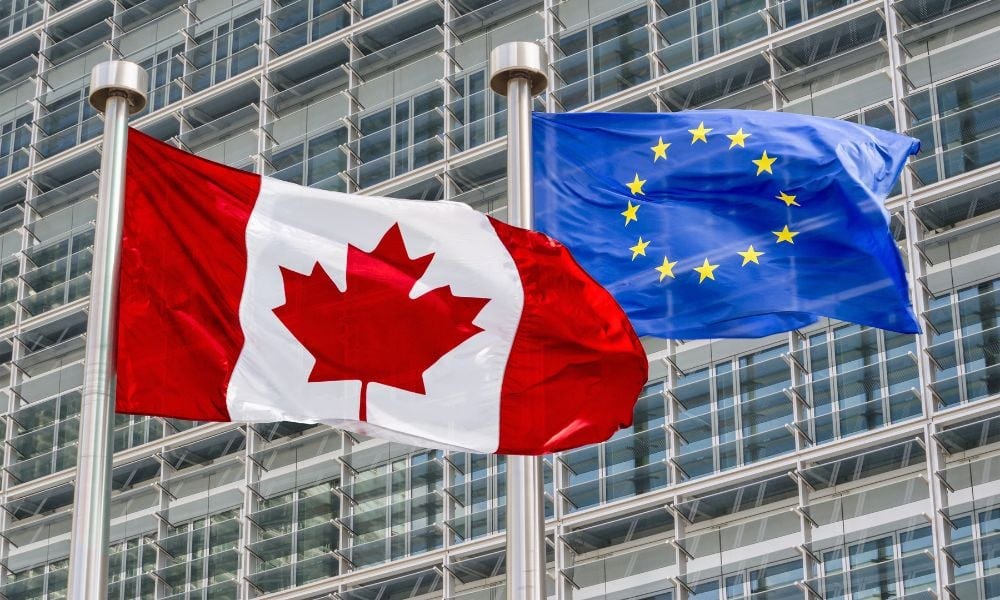
In her proposal for a new “Alliance of the Future”, EU President Ursula von der Leyen outlined a vision for “a common prosperity and economic security space” between Canada and the European Union. This proposal would include Canada becoming an “Associate Member” of the EU. Canadian Prime Minister Mark Carney welcomed this proposal and called for closer cooperation between Canada and the European Union while referencing the challenges of the ongoing “Geopolitical Rupture” in the world. President Trump called the plan “laughable” and threatened additional tariffs on Europe.
I’ve spent several years studying the expansion of the European Union and the legal process of European integration (including reading the European Federalist Papers many summers ago…). Considering that this field is grounded in analyzing treaty text and legal processes, things tend to move at a glacial pace and major developments are broadcasted well in advance. This makes the announcement of Canada’s potential “Associate Membership” a unique surprise.
First and foremost, this proposal would represent the first westward expansion of the EU. EU membership forecasts are mostly focused on the Western Balkans, the South Caucasus, and countries like Ukraine and Moldova that are located along the eastern periphery of the union - I don’t think Canada was on anyone’s bingo card for “next member of the European Union”.
Additionally, enlargement of the European Union often involves the political transformation of a prospective member. In the 1990s many former communist countries used the goal of future membership in the European Union as a vehicle for implementing free market and democratization reforms. In recent years, emerging democracies like Ukraine and Armenia have tied EU membership aspirations to anti-corruption efforts. As an already democratic society with a free market economy, it’s unclear what political changes would come with Canada’s new partnership with the European Union.
There’s also the question of what exactly President von der Leyen meant when she described Canada as a potential “Associate Member”. The European Union has three labels used for partner countries: “member states” , “candidates”, and “associates”. Member states are part of the “Single Common Market”, a continent-wide free trade area and shared customs code that is designed to facilitate the free movement of goods, people, labor, and services between members (essentially a European analog to the United States’ Commerce Clause). Member states also participate in the union’s political decision making processes and adhere to all laws, standards, and regulations set by supranational authorities like the European Commission.
“Candidate” countries have been officially recognized by the EU as potential future members. They are expected to comply with all the rules and regulations of the EU but do not participate in any of the EU’s decision-making processes. Candidacy is not a guarantee of membership and the accession process is a long, complicated process that takes years (if not decades) to complete. Membership prospects can be frozen due to political considerations, derailed by democratic backsliding, or outright vetoed by a single EU member during a diplomatic row with a candidate country.
“Associate” of the European Union is a tricky label. Officially, any country that holds an “association agreement” is an associate of the European. Association agreements typically include partial integration with the Single Common Market and some form of alignment with the EU’s political systems. However, unlike candidate countries, EU Associates are not expected to continuously integrate themselves into the political and economic systems of the European Union. For instance, Norway and Iceland are two associates of the European Union that are politically aligned with the EU and nearly fully integrated into the Single Common Market. However, both countries have avoided full membership in the EU in order to preserve national control over critical industries (fishing for Iceland and energy extraction for Norway). For these two states, the economic benefit of retaining national control over these industries outweighs the lack of inclusion in the EU’s political decision making process.
With all this in mind, we must turn our attention back to Canada: what exactly can we expect from an “Associate Member”? There’s nothing stopping Canada and the European Union from allowing the free movement of people, goods, and services between one-another - although the literal ocean between both parties raises the question of just how practical this sort of agreement would be. Participation in the Single Common Market is technically possible, however this would likely be an elaboration of already existing free trade agreements between Canada and the EU.
I would argue that the most important element of Canada’s “Associate Membership” with the European Union relates to security and defense.
More specifically, we should recognize that Associate Membership opens the door for Canada’s inclusion in the EU’s collective security framework. The European Union has two collective defense clauses that are similar to NATO’s Article 5. Article 42.7 of the Treaty of Lisbon, known as the “Mutual Defense Clause”, calls for members of the European Union to come to the aid of another member in the event of an armed attack. Additionally, Article 222 of the Treaty of the Functioning of the European Union requires EU members to jointly coordinate their responses to events like a terror attack or natural disaster.
The European Union’s defense policy portfolio includes much more than just mutual security clauses. The Common Security and Defence Policy (CSDP) is a collection of defense projects, multinational deployments, and union-wide defense plans that include the operation of rapid-response EU Battlegroups and the coordination of weapons manufacturing and procurement. Canada has already seen success working with the EU’s CSDP through its participation in the European Union Monitoring Mission in Armenia - it’s entirely possible that Canadian personnel join an EU peacekeeping mission or deployment to Ukraine or Taiwan.
A Divided Atlantic?
NATO and the EU have historically been considered complimentary pillars of the Transatlantic alliance. However, with the second Trump administration’s adversarial approach towards relations with the European Union and expansionist rhetoric towards Canada and Greenland, many allies are reexamining whether or not the United States will actually uphold NATO’s security guarantees in a crisis. Denmark, a NATO member and ally of the United States, has already directed counterintelligence operations towards American citizens in Greenland suspected of conducting influence operations.
Canada’s participation in the EU’s “Alliance for the Future” may signal the first major divide in the Transatlantic partnership. In the short term, Brussels and Ottawa may act as a united front against the Trump administration’s erratic tariff policies and coordinate retaliatory economic measures. With the dysfunction seen in the Five Eyes intelligence sharing alliance under FBI Director Kash Patel, Canada may view Europe as a preferred partner for threat forecasting and counterterrorism coordination. In the long-run, Canada’s alignment with the European Union may present larger, structural challenges for the United States. Canadian adoption of EU regulations for food safety may limit the United States’ ability to negotiate bilateral trade agreements with Canada (historically, disparities between American and European health standards have been a major hurdle to EU-US trade deals - disagreement over “Chlorinated Chicken” is a well known example). Canada may join Europe’s strategy for digital autonomy and move critical systems away from American networks. Additionally, Canadian-European defense alignment presents the possibility that Canada chooses European arms and aircraft as an alternative to American defense tech. The economic and political impacts of above are heightened when we consider that this would be a needless, self-induced schism with one of two countries directly bordering the United States.
There are several retaliatory measures that Trump administration could deploy in response to this proposed alliance. Having already levied tariffs against Canadian and European goods, the second Trump administration could raise tariff rates even further or declare a full ban on imports from either Canada or the EU. Trump could also unilaterally suspend defense cooperation with Canada or limit the ability of American and Canadian citizens to travel to either country as a punitive measure. There’s also the possibility that the Trump administration sabotages the ratification of Canada’s “Associate Membership” by either securing a veto vote from a single EU member or mobilizing Quebec’s autonomous government against the ratification process (recent reporting suggests that the Trump administration has already attempted to use Quebecois separatism against Carney’s government).
Looking beyond the Trump administration’s potential reactions to this treaty, we must also consider how this alliance could benefit the United States in a future administration. If Brussels and Ottawa are successful in securing Canada’s Associate Membership and the “Alliance of the Future” delivers on the vision for common prosperity and economic security, this new union may become a true successor to NATO. By fusing political, economic, and security cooperation into one structure, the Alliance of the Future would supersede NATO’s original focus and command enough military and economic weight to match the rising challenge of China. By signing a bilateral treaty with this alliance, the United States may open new avenues of cooperation in emerging industries that were not available through previous trade agreements. The treaty structure used for Canada’s Associate Membership could be recreated for a future agreement between Ukraine and the EU - or Ukraine could be included as the third member of the alliance. Membership in the Alliance of the Future could even be extended to strategic partners like Japan, Taiwan, and Australia that fall outside the geographic area associated with NATO and the EU.
Time will show as to what becomes of Canada’s proposed EU Associate Membership and if the “Alliance of the Future” materializes as an actual political union. What is clear, however, is that the United States’ inward retreat from the global stage has created a power vacuum that our enemies and allies are desperate to fill. In a time of rising authoritarian powers, the Alliance of the Future may emerge as a counterweight that is centered on defending democracy across the globe.
We see the world with the same eyes: from AI to climate change, from the Arctic to geopolitics. And we have stood together: on Ukraine, on defence, on raw materials and on supply chains. But above all, dear Mark, Europe and Canada believe in democracy. We believe that power does not belong to the strongest, the richest or the loudest – but to all of us. That democracies have the freedom to choose with whom to work.
-EU President Ursula von der Leyen