

Dear readers,
Tomorrow, September 17th at 5:30pm ET, I will be broadcasting live on Substack! I will be reviewing this week’s events and answering any questions you have for me on international affairs, national politics, and the upcoming midterms. Paid Subscribers can ask questions in this chat linked here.
Join as a paid subscriber today and ask questions in the chat linked here. Be sure to download the Substack app to tune in. I look forward to speaking with you tomorrow!
Three developments unfolded in Ukraine this week that appear separate yet are closely related: Trump announced a truce that resembles one which we’ve already seen fail, a Russian drone struck a train near the Polish border only minutes after a different train carrying senior Western officials had passed through the same station, and on an otherwise unremarkable night Russia launched more than 860 drones at Ukraine (most of which Ukrainian air defense shot down). Individually, each of these reads like a discrete news item, yet when put together they show where this war actually stands and how far NATO’s strategy and understanding still lags behind.
The Truce That Isn’t
Donald Trump announced on Truth Social that Ukraine and Russia have agreed to stop striking each other’s energy infrastructure. Trump framed this as a diplomatic win and, revealingly, described it as a fix for rising diesel prices. This suggests that the White House wants to tie the recent spike in prices at the pump to the war in Ukraine rather than to the chaos unfolding in Iran and the Middle East.
I want to be precise about what actually happened here because the gap between the announcement and the facts on the ground is the real story.
We have been here before. In March 2025, Trump and Putin announced almost the identical arrangement: a mutual pause on energy and infrastructure strikes. This was framed by the the White House as a first step toward a broader ceasefire. Zelenskyy went along with it publicly. Within days, Ukraine was documenting Russian violations of that pause (more than thirty of them by its own count). The strikes didn’t stop. The war didn’t pause. The announcement simply stopped being operative, quietly, without anyone in Washington having to say so.
Eighteen months later the choreography is repeating and the terms are, if anything, vaguer this time. There’s no confirmation from Kyiv or Moscow on when this agreement would take effect, what counts as an “energy target,” or how compliance would be verified. Zelenskyy’s own response was notably careful - he welcomed the idea of ending strikes on infrastructure in principle but made clear no formal agreement exists, and clarified that Ukraine needs concrete guarantees, not a social media post, before it changes what it’s doing on the battlefield.
This pattern is familiar: announce a deal before the deal exists, let the announcement do political work (lower diesel prices, project momentum, generate a news cycle) regardless of whether the underlying commitment holds. I saw versions of this instinct up close in my time on the NSC. The danger isn’t that a truce gets announced prematurely, it’s that repeated premature announcements erode the value of any actual treaty that eventually gets signed because both allies and adversaries learn that the announcement and the reality are two different things. Watch what happens in the next 72 hours, not what got posted on Truth Social. If Russian strikes on Ukrainian energy infrastructure continue past today we’ll have our answer about how seriously to take this one. Spoiler, the truce announcement shouldn’t be taken seriously.
Putin’s Brush-Back Pitch
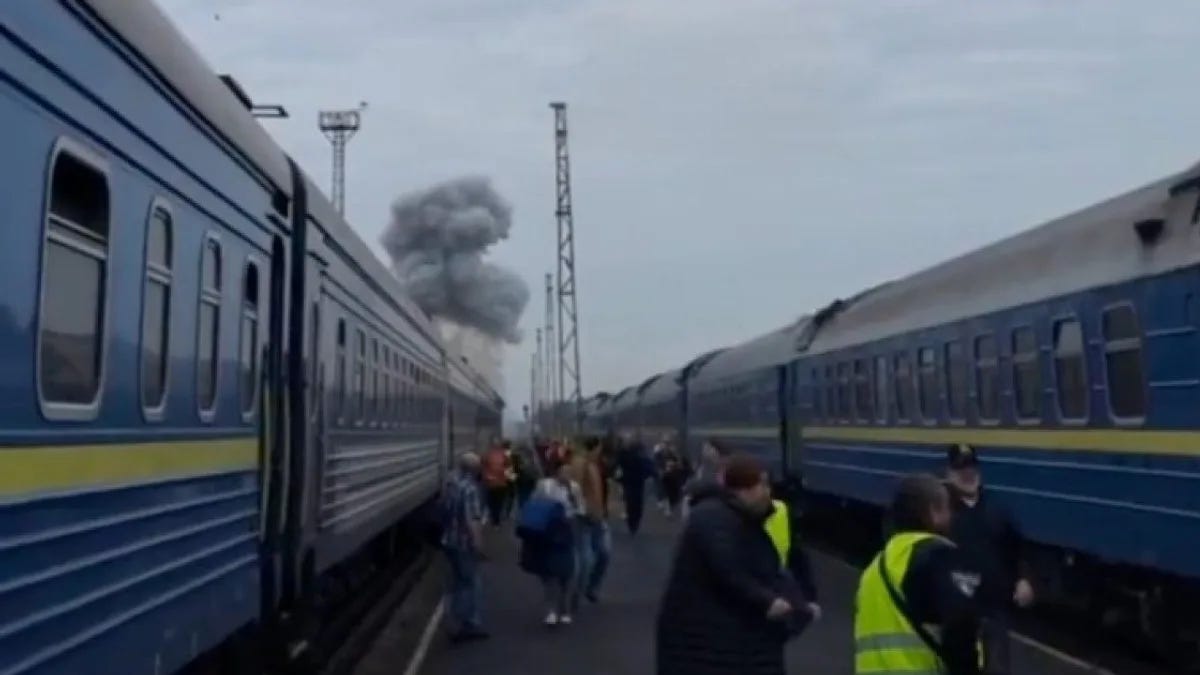
On the same weekend as Trump’s announcement, a Russian drone struck a passenger train two kilometers from the Polish border just minutes after a different train had passed through the same station carrying Boris Johnson, Carl Bildt, David Petraeus, and a delegation of European security officials returning from Kyiv. No one was hurt, which almost misses the point given the timing.
Ukraine’s rail operator said the diplomatic train had left ahead of schedule precisely because Kyiv adjusts its timetables in real time to account for the constant threat of Russian strikes. If that account holds, then the train that was hit wasn’t the wrong target - it was the second-best target since the intended one had already left.
I don’t think this was random and I don’t think the Kremlin needs it to look accidental. There’s a long tradition in Russian strategic signaling of actions that carry plausible deniability on the surface and an unmistakable message underneath. If you strike close enough to a NATO border on a route known to carry senior Western officials just days after drone incursions into Poland-proper, then you don’t need to hit the target to send a message: “we can reach this close to you whenever we choose and we are willing to target NATO and Western leaders”.
NATO Secretary-General Mark Rutte called this a sign of Putin’s desperation, and he may be right, but I’d put it differently: desperation and calculated escalation aren’t mutually exclusive and reading this purely as weakness risks underestimating what it’s actually testing. This is a probe of Western resolve along the exact faultline where the war in Ukraine and NATO’s Article 5 commitments meet. This kinetic activity on the Eastern frontier of NATO is a pattern that Putin has been testing methodically for the better part of four years, from the drone incursions into Polish airspace last September to a string of sabotage incidents across the continent that Poland’s foreign minister has now explicitly linked together as a single campaign, not a series of coincidences. A strongly worded statement won’t cut it. What’s needed is a visible, immediate hardening of the air-defense and border posture along exactly the corridor this drone flew through that carries Western aid and Western officials into Ukraine. If Moscow is testing whether these corridors are contestable, then the only credible answer is to make unmistakably clear that they are not. I’ve written and will continue to write about for assertive and necessary action necessary to reestablish NATO deterrence.
The Drone Gap
This all brings me to the story that should worry policymakers more than either of the other two: NATO’s frontline states are still years behind the threat that Ukraine has been managing for more than four years running.
Consider the numbers from a single 24-hour period: Russia launched more than 860 drones at Ukraine in a single night and Ukrainian air defense intercepted or neutralized the majority of them. This is a genuinely impressive rate built on four years of iterative (and often improvised) innovation under fire. That’s the capability gap nobody in Washington or Brussels likes to say out loud: Ukraine’s counter-drone systems, doctrine, and industrial base are, in important respects, ahead of NATO’s because Ukraine has been forced to build them in combat while the alliance has been building them in committee.
The train strike near the Polish border is a preview of what happens when that gap crosses into NATO territory. Poland’s own airspace was breached by Russian drones a year ago. The response since then, “Operation Eastern Sentry,” saw the deployment of additional allied aircraft and a hardened border posture. While these are real changes to our posturing, this is a fundamentally reactive strategy and is built exercise-by-exercise rather than as part of an integrated, alliance-wide counter-drone architecture. Unfortunately, this threat isn’t waiting for NATO’s procurement and decision-making cycles to catch-up.
This is precisely the lesson I’ve tried to build into my foundation’s work: the technology and doctrine coming out of this war need to move into Western policy faster than they currently do, and that requires connecting people who’ve actually built and fielded these systems under fire with the policymakers who control the budget lines. Cheap, mass-produced drones and the countermeasures to defeat them are not a niche procurement question anymore. They are the leading edge of how this war, and the next one, will actually be fought.
Congress just finished a defense authorization bill that expands counter-drone investment. This is a step in the right direction, but authorization isn’t fielding equipment, and fielding takes years that the alliance may not have. The NDAA mentioning drones doesn’t answer the real question, which is whether the systems Ukraine is using tonight to shoot down hundreds of Shaheds are anywhere close to being fielded on NATO’s own eastern flank. In the near future someone may decide to test that flank directly instead of just brushing past the periphery.
The Through-Line
Moscow is navigating the diplomatic track, the escalation track, and the capability gap at the same time and with more coherence than the Western response has shown to any one of them. The truce announcement lowers the political temperature without changing anything on the ground. The strike near the Polish border tests NATO’s nerve at its most sensitive frontier. Underneath both of these developments the drone war grinds on, exposing a capability gap the alliance has no real plans to close. None of it should be read as a one-off and treating any single piece in isolation is how the West ends up reacting to Moscow’s timeline instead of setting its own.
I have not seen anything about Ukraine's fight to stay alive absent the caterwauling from DJT about using the drone-wrecking Ukraine attacks on Russian diesel fuel assets being blamed for the stupendous rise in USA diesel prices. Meanwhile the stranglehold in the two-strait knot gets tighter after our brilliant military non-war with Iran has raised both hackles and prices world-wide because our military is so fecklessly headed by a doddering president who thought the Hormuz strait would be a piece of cake. Take your Marie Antoinette act somewhere else, Mr. Trump. You are just an overbearing, unintelligent, selfish, grubbing clown. And I hope you step down soon.