

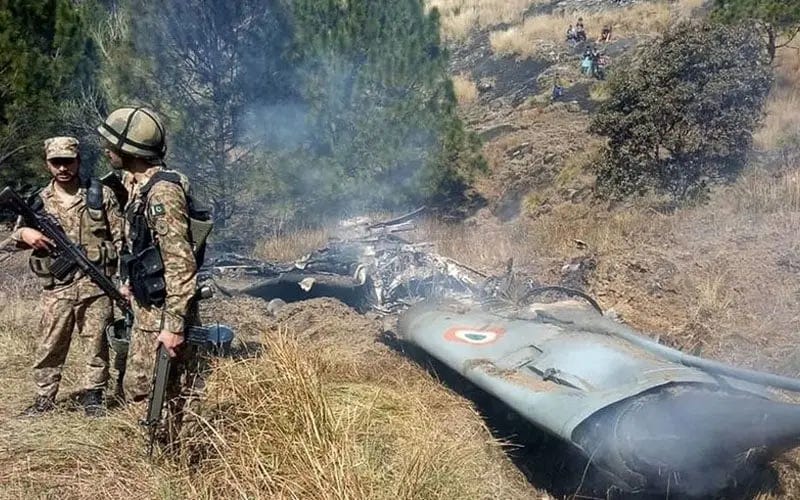
The wreckage of an Indian warplane shot down over Pakistani territory (AFP)
According to recent reporting from the Washington Post, India and Pakistan are adhering to a temporary ceasefire that was announced on May 11th. While social media users continue to report isolated explosions and air raid siren activations along the border of both countries, there is no indication at this time that either party intends to resume fighting. Given that both the Indian and Pakistani governments maintain their current military posturing and are presenting this spring’s skirmishes as grand victories for their respective militaries, we can assume that neither country will unilaterally stand down and demobilize - meaning that the current peace between both states is tenuous at best.
The recent fighting between India and Pakistan included heavy usage of air-launched standoff munitions, ballistic missiles, and long-range loitering munitions. While infantry, armor, and mechanized formations were present along the line of contact and had the potential to be deployed, Indian and Pakistani military leadership focused on using long-range strategic weapons and aerial assets. Over three days of fighting, air defenses like the Russian-built S-400 and Chinese HQ-9/P engaged fixed-wing aircraft like the Rafale, J-20, and Mig-29. Even without further conflict, the 2025 India-Pakistan skirmishes will be viewed as a case-study for numerous modern aircraft and air defense systems. Additionally, the volume and scope of misinformation and disinformation shared by both sides of the conflict will be of great interest to any researchers examining social networks in times of war.
More than anything, I feel that the skirmishes between India and Pakistan have shown us the limits of the isolationist doctrine of the second Trump administration. Shortly after the start of the fighting, Vance claimed that a war between India and Pakistan was “none of our business” and positioned the United States as a neutral party. However, the United States later emerged as the leading negotiator of the current ceasefire between both countries. According to recent reporting from the New York Times this sudden change in policy was in response to India’s decision to conduct a missile strike on an airbase located near the headquarters of Pakistan’s nuclear weapons program. This decision was seen as too-great of an escalation and was enough to spur American intervention. This raises the question, what if cooler heads hadn’t prevailed? What if the Pakistani government took Vance’s statement as a sign of American disinterest and immediately responded to India’s actions with a retaliatory strike? Will the United States be willing to deter similar strikes on sensitive targets in the future and if so, would India view this as favorable treatment towards Pakistan? These uncertainties would be avoided if the United States took a proactive and clearly articulated stance towards deescalation in the conflict at the start of the fighting. It’s possible that Vance’s indifference was viewed by both parties as implicit approval towards further military action. Unless the administration course-corrects and engages with India and Pakistan, then we will likely see the collapse of this ceasefire in the near-future.
Vance & others in the Trump admin are flying by the seat of their pants much of the time, partly because they are under qualified, to say the least, and at other times because the truth is not favourable to them.
It is therefore repeatedly said that they ‘are not serious people’. They will take the path of least resistance and make the fewest commitments possible when things are not decidedly in their favor and only commit when they can have an EASY WIN.
Trump, for all his bravado, is a coward at heart & has zero military experience — and it shows.
— a ‘showboat’ is running the show here. * Putin knows this too.
Thank you Col. Vindman, I cannot think of anything more stupid to fight over than religion. Of, course, it is probably more difficult for me as a non-theist to comprehend the emotions of those involved. If you really and truly believe in your god, why must every other person share your belief? Are you so doubtful of your own belief that you need constant validation. My understanding is Pakistan broke away from India many, many years ago because those in what is now Pakistan are mainly of the Muslim faith, while those in India are primarily of the Hindu faith with a few other beliefs are thrown in. How about using a little bit of intelligence to mix up "beliefs"?