

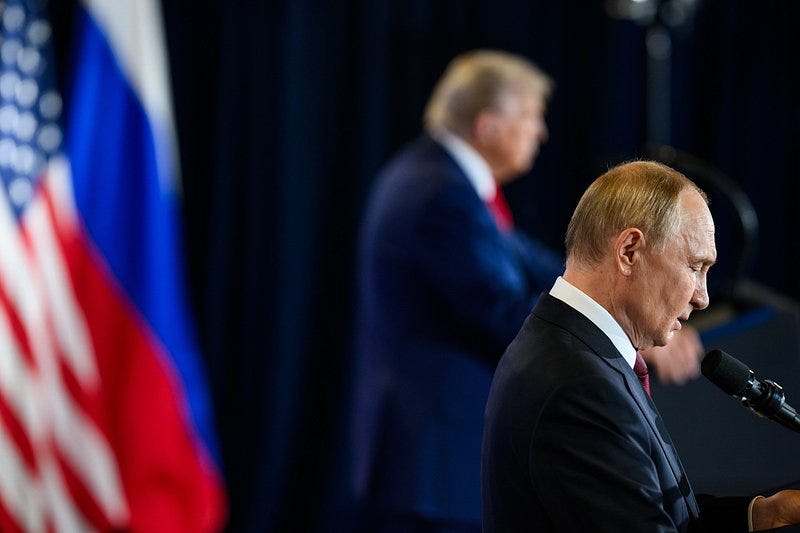
According to recent reporting from the Wall Street Journal, the Russian government has proposed a trilateral meeting between Putin, Trump, and Xi Jinping to discuss the resolution of the war in Ukraine. Putin reportedly first raised the idea during an October 9th phone call with Trump, the same call that preceded the diesel deal and the subsequent shut-off of American intelligence sharing with Ukraine. The meeting would likely take place on the sidelines of the APEC summit in Shenzhen, China on November 18–19. Kremlin spokesman Dmitri Peskov has confirmed that discussions are underway, and a senior U.S. official said Trump has not agreed to attend but could be receptive. Ukraine would not be at the table. Ukrainian Foreign Minister Andrii Sybiha has stated that the proposed summit would only lead to more aggression from Moscow. When considering the decisions that the administration has made in recent weeks regarding American support for Ukraine and US-Russia rapprochement, it’s clear that Trump is both interested in this trilateral format and predisposed to deliver for Russia and China at the expense of Ukraine and almost certainly Europe and the United States.
I have long been a critic of the transactional approach taken by this administration and the numerous short-sighted decisions that have crippled Ukraine’s defense and needlessly torched American-European relations. This summit might very well augur something even more serious. It is completely plausible to describe the potential Putin-Trump-Xi meeting as the negotiated end to the post–World War II order and the definitive end of the American century. At Yalta in 1945, three leaders carved up postwar Europe, deciding Poland’s future without Poland at the table. But Yalta came paired with the founding of the United Nations and the institutions that would restrain great-power appetites for decades. A Putin-Trump-Xi summit would be Yalta in reverse: the same carving of spheres and the same absent victim, but this time dismantling the institutions rather than building them. Just as Yalta shaped the Cold War, the trilateral Putin-Trump-Xi conference will shape the inevitable conflicts of the near future.
Let’s consider what this meeting would mean for each of the proposed guests. For Putin, a trilateral meeting with Trump and Xi would be a clear PR victory that would affirm Russia’s desire to be viewed as a superpower. With Trump already literally rolling out a red carpet for Putin during the Alaska Summit, this meeting would be seen as another instance of the United States compromising its own efforts to isolate Russia in exchange for meaningless pledges from Putin. Additionally, the trilateral summit may deliver to Putin through diplomacy what Russia has failed to achieve militarily: the full capture of Donetsk Oblast and the capitulation of the Ukrainian government. It’s possible that the three heads of state come to the conclusion that a lasting peace can only be secured if Ukraine surrenders the Fortress Belt and surrounding territory. Any protest from Kyiv against this proposal may result in a combination of continued Russian military activity alongside new sanctions from the United States and China. No matter the outcome, Russia benefits from this trilateral meeting. I would also note that surrendering the Fortress Belt now, even for a truce, would compromise Ukraine’s security and leave Kyiv and the entirety of Ukraine vulnerable to the next attack from Moscow.
For China, Putin’s proposed trilateral gathering presents a unique opportunity. The United States and China have navigated their increasingly contentious relationship by viewing one another as peers with no equals (as the world’s two largest economies, together accounting for more than 40 percent of global output). Deep economic interconnectivity has prevented both states from unilaterally escalating tensions and both Beijing and Washington have a mutual interest in preserving international trade. The presence of Russia, a country that barely trades with the United States and is considerably more confrontational with Washington than Beijing, means that China will have an outlet for the political demands that would be otherwise smothered by the need to preserve economic ties. Xi could even present China’s demands as being a moderate middle-ground between Russia’s maximalist positioning and the United States’ historic approach towards Ukraine and European security. There’s also the reality that this summit would be a 2-vs-1 match between a hapless Donald Trump and two crafty adversarial countries that have individually shown themselves to be capable of manipulating him. Proper coordination between the Chinese and the Russians could lead to unthinkable unilateral concessions from the United States.
Finally, there’s the question of what this meeting would mean for the United States. The second year of Trump’s second term has been defined by his decision to launch a needless, thoughtless, and dangerous war with Iran and his administration’s struggle to handle the ongoing political fall-out from this decision. A trilateral summit would provide a short-lived public relations win for the Trump administration (even if the summit is actively protested against by members of his own party, the intelligence community, and broader American public), at the expense of a whole series of long-term interests. In the best case scenario, Putin and Xi will promise to help Trump exit the Iran war with a whole slew of concessions. Trump will likely surrender America’s positions on Ukraine security aid and NATO’s model of collective security in exchange for a face-saving exit from Iran: reopened shipping through the Strait of Hormuz, perhaps on terms that leave Tehran with leverage over it, paid for with American concessions of its own, including unfrozen Iranian assets and a U.S.-backed fund to rebuild Iran. Telegraphing these possible developments over the next two weeks could provide a cheap diplomatic win before the midterms. This is especially true if the meeting is predicated on a meaningless guarantee from Putin and Xi that Trump will accept at face value and repeat at home - like how China and Russia will ensure that Iran will never get a nuclear weapon or that a new deal has been reached to lower gas prices. The actual agreement that Trump would present to the American people would once again be meaningless and on some level, Russia and China are likely aware of this too. However, we are risking the possibility that cornerstone elements of the post-war order are used by the United States as bargaining chips for empty promises ahead of a disastrous midterm election.
The danger is an understanding between Putin, Trump, and Xi that the world will be partitioned into three distinct spheres. Russia will have direct dominion over Ukraine and de facto control over continental Europe. China will control the Asia-Pacific with Russia ceding influence over Central Asia and America softening its security commitments towards Taiwan, Japan, and Australia. The United States will have de facto control over the Western Hemisphere, having exchanged its place at the forefront of the post-war international order for a militarized sphere of influence over neighboring countries that would otherwise be allies. The final results of this trilateral summit - and the resistance to the vision presented by these three autocrats - may shape the coming conflicts of the 21st century.
That resistance has to start now, before Shenzhen. Congress should demand to know in advance and in public what the administration intends to put on the table and make it clear that commitments to Ukraine, NATO, and our Pacific allies are not Trump’s to trade away in a side meeting. Europe, Japan, and Australia should coordinate before November rather than learn the terms afterward. And no one should accept a settlement on Ukraine negotiated without Ukraine. Yalta taught us what happens when great powers decide the fate of smaller nations behind closed doors. We should not need to learn that lesson twice.